建築環境シミュレーション学研究室(Numerical Simulation of Architectural Environment)-劉 城準(Yoo Sung-Jun)准教授
建築分野からのCO₂排出量は、日本全体の約3割を占めており、カーボンニュートラル社会の実現に向けて、建物の省エネルギー化は極めて重要な課題となっています。一方で、近年のコロナ禍を契機として、人々の健康や快適性、さらには心理的充足を含む「ウェルビーイング」への関心がこれまで以上に高まっています。このような社会的背景のもと、省エネルギー性能の向上と人間のウェルビーイングを両立させる建築環境設計が強く求められています。
健康的で快適であり、かつ高い生産性を支える室内環境を実現するためには、温熱環境や空気質などの室内環境要素と人体との相互作用を総合的に理解し、定量的に予測・評価することが不可欠です。しかし、実験を中心とした従来の研究手法には、時間・空間・コスト、さらには倫理的側面における制約が存在します。
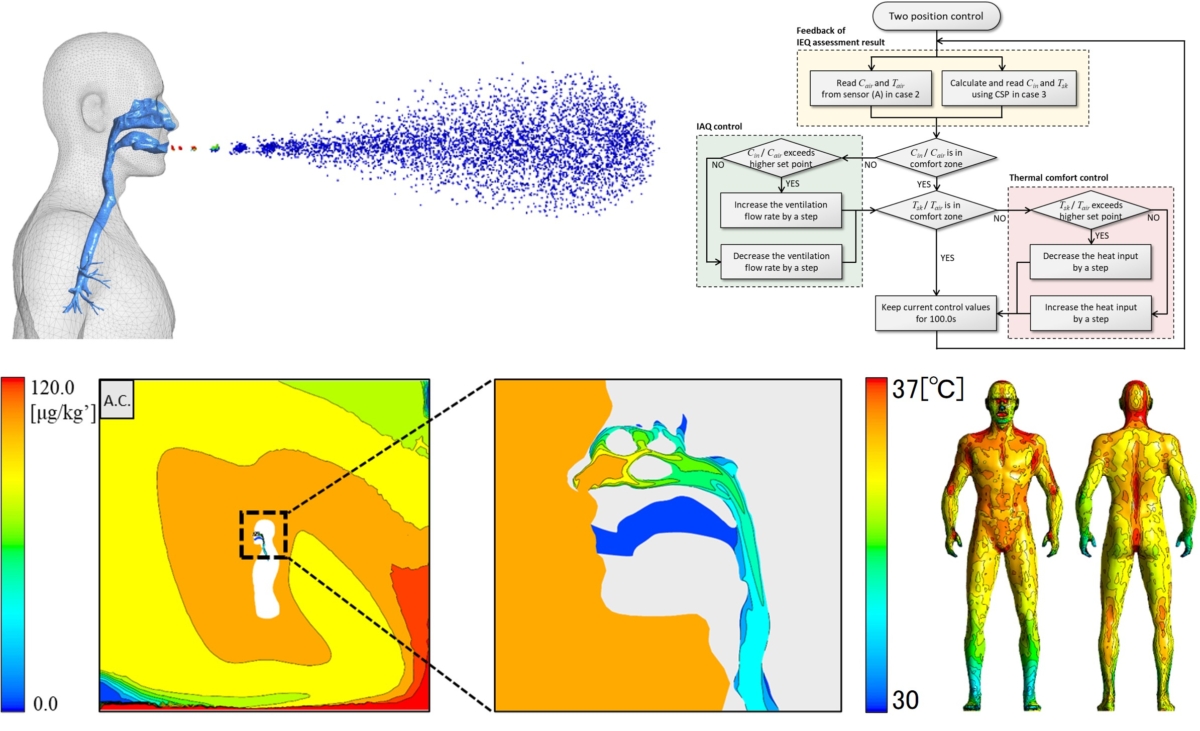
当研究室では、こうした課題に対し、建築環境のデジタルツインを基盤とした数値シミュレーションを活用し、熱環境や空気質に代表される室内環境の質と、人間の健康・快適性との関係を統合的に評価可能な数値解析モデルの開発に取り組んでいます。これらの研究を通じて、省エネルギーとウェルビーイングを両立する建築環境設計・評価手法の確立を目指しています。
-主な研究テーマ-
- 数値人体モデルを使用した室内空気質・熱快適性の総合評価
- 室内環境設計及び空調制御の最適化に関する研究
- 数値人体モデルの高度化に関する研究
- 空調・換気設備の最適設計に関する研究
—————————————————————————————————–
The building sector accounts for approximately 30% of total CO₂ emissions in Japan, making energy efficiency in buildings a critical issue for achieving carbon neutrality. At the same time, public awareness of human health, comfort, and overall well-being has increased significantly in recent years, particularly in the wake of the COVID-19 pandemic. Under these circumstances, there is a growing demand for building environmental design that not only reduces energy consumption but also enhances human well-being.
To create indoor environments that are healthy, comfortable, and productive, it is essential to comprehensively understand and quantitatively evaluate the interactions between indoor environmental factors—such as thermal conditions and indoor air quality—and the human body. However, experimental-based research approaches are often constrained by limitations related to time, spatial scale, cost, and ethical considerations. In response to these challenges, numerical simulations based on digital twins of building environments have recently attracted increasing attention as a promising research approach.
Our laboratory focuses on the development of numerical modeling frameworks that enable integrated evaluation of indoor environmental quality, including thermal environment and air quality, and their impacts on human health and comfort. By applying these models, our laboratory aims to establish advanced building environmental design and evaluation methodologies that achieve both energy efficiency and human well-being.
-Main Research Topics-
- Comprehensive estimation of indoor air quality and thermal comfort using Computer-simulated Person
- Optimization of indoor environmental design and HVAC control strategies
- Development of advanced Computer-simulated Person
- Optimization of air-conditioning and ventilation system design